More projects

.png)
.png)
Team Profile Editor
A centralized profile management tool designed to streamline how Investment Advisors and Branch Managers update and maintain their information across multiple Wealth Management platforms.
.png)
TL;DR
Role: Product Designer
Timeline: Apr 2024 – Mar 2025
Team: Design Lead, Product Owner, Senior Business Analyst, Developers
Status: Live as of March 2025
Context
TPE (Team Profile Editor) is a centralized employee and team data platform designed to replace the outdated 2018 TeamView MVP. Advisors previously spent 27 minutes per update and duplicated information across four different systems, resulting in inaccuracies in client-facing reports and significant operational friction. The business initially requested a “visual Excel upgrade,” but discovery revealed deeper governance, data quality, and workflow problems.
What I Did
- Conducted discovery, audits, and workflow mapping to uncover systemic issues in the legacy process.
- Advocated for a platform-level redesign rather than a cosmetic UI refresh.
- Designed automated data syncing, flexible team structures, delegation flows, and approval visibility.
- Simplified complex business and compliance rules into intuitive user journeys.
- Facilitated alignment across product, SMEs, and engineering to ensure feasibility and avoid rework.
- Led usability testing that informed iterative improvements and validated workflow efficiency.
Impact
- 57% reduction in task time during usability testing.
- Significant reduction in manual effort and data duplication for advisors and internal teams.
- Improved accuracy of team information across Wealth Management platforms.
- Modern, scalable system that supports richer team profiles (bios, photos, designations, social links).
- Shifted business direction from a narrow UI update → a long-term foundational platform.
Full Case Study
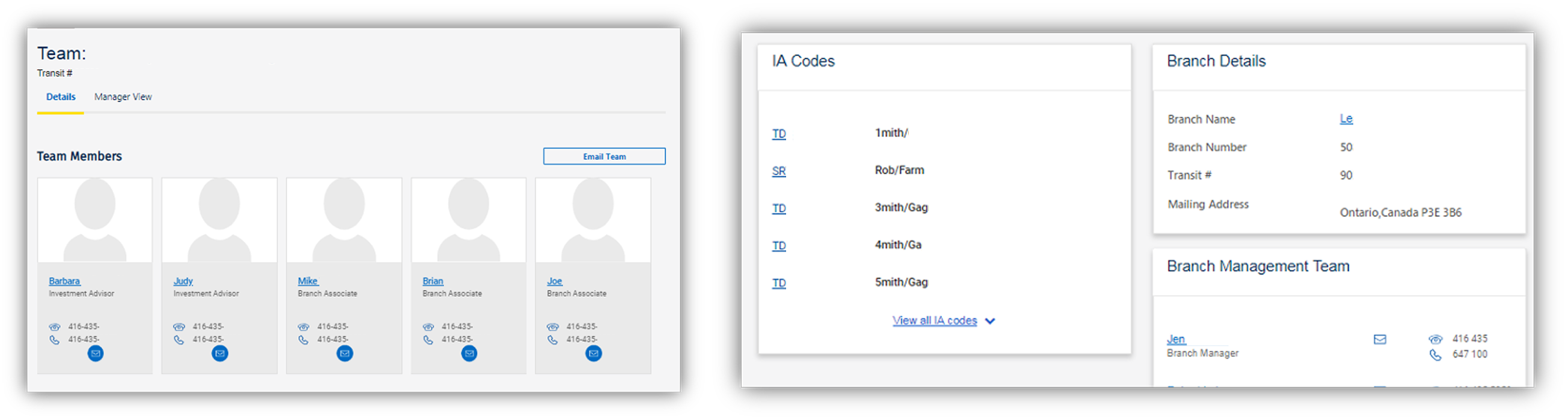
Investment Advisors (IAs) in Wealth Management rely on accurate personal and team profiles that feed into client-facing reports, marketing touchpoint, and internal systems. However, this information was being managed through TeamView, a lightweight MVP built in 2018 on the WM platform. While TeamView provided quick access to branch and IA details, it relied heavily on manual intervention and hadn’t evolved with business complexity.
This created several systemic issues:
- Advisors updated information across 4 disconnected systems.
- Manual edits caused inconsistent client-facing reports.
- Team structures (shared books, secondary teams, support roles) were not reflected accurately.
- Employee-level content such as bios, designations, and photos had no single source of truth.
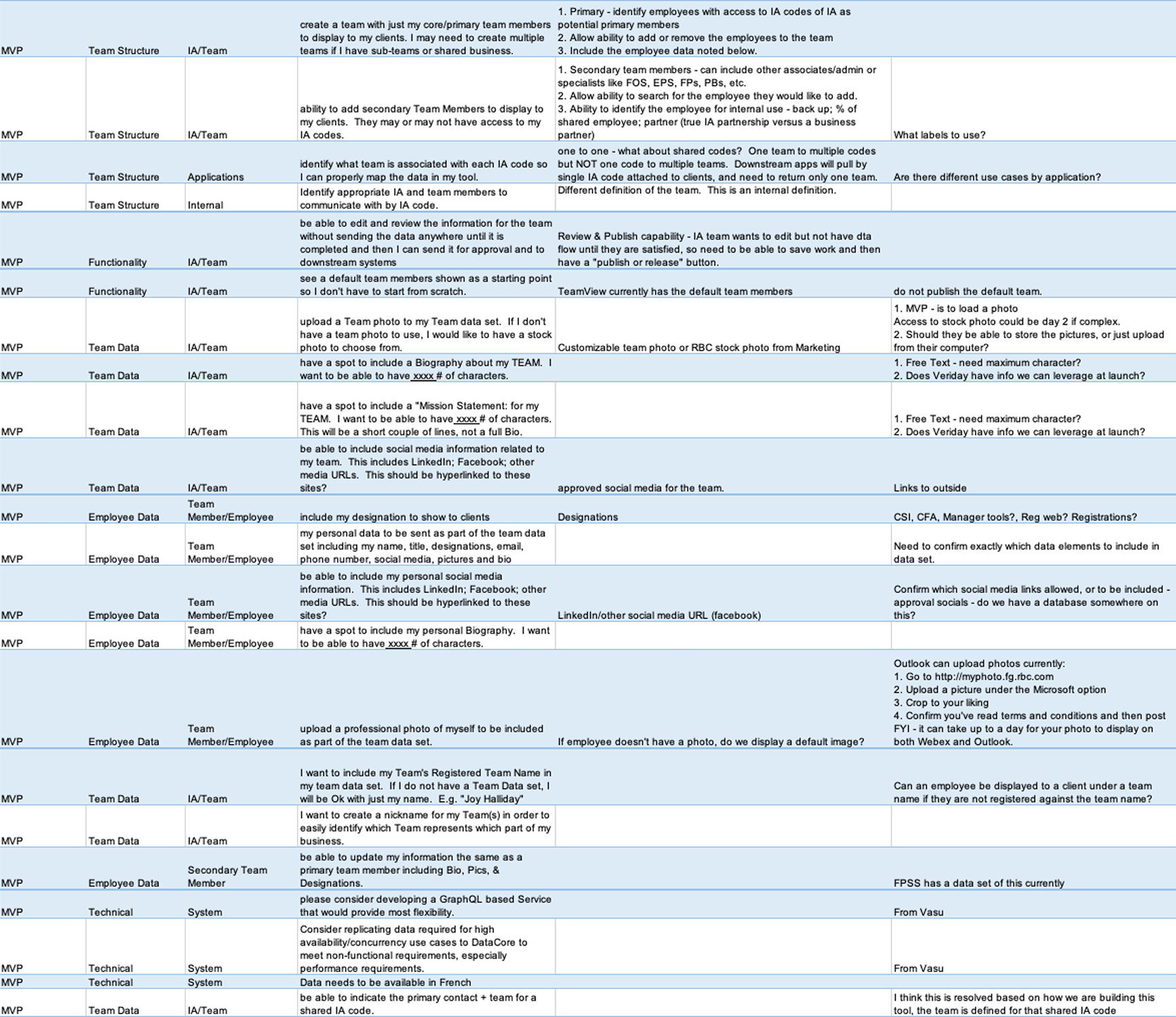
Business requirements had also grown beyond TeamView’s original scope. The new solution had to support:
Business Requirements
1. Team configuration
- Core teams for client-facing roles
- Optional secondary teams
- Teams within teams (shared business)
- Correct mapping of teams to IA codes
- Accurate identification of team members for internal communications
2. Team-level data
- Team photos
- Team bios
3. Employee-level data
- Photos
- Bios
- Designations
- Social media links (LinkedIn, Facebook, etc.)
This presented a clear opportunity: evolve TeamView’s “single view of the team” into a centralized, scalable source of truth for all employee and team data across Wealth Management.
The Challenge
Advisors faced measurable friction in the existing process:
Pain Points
- Time burden: Average profile update required 27 minutes, mostly due to repeated manual entry.
- Duplication across systems: Users entered the same data into 4 systems.
- Operational delays: When advisors were on leave, proxy updates took 15–40 additional minutes.
- Data inconsistencies: Outdated contact info or bios occasionally surfaced in client-facing reports, a reputational and compliance risk.
Success Criteria (Set Early)
- Reduce advisor update time by ≥50%
- Reduce duplicate records from 4 copies → 1 canonical source
- Reduce delegation overhead to ≤2 minutes
- Increase satisfaction (target +30% improvement)
Discovery & Audit
When the project began, the business approached design with a near-complete Excel solution and expected a visual treatment. I reframed the engagement by walking stakeholders through the design process and emphasizing the need to understand the system, not just the UI.
What We Did
- Mapped end-to-end workflows with PO, BA, and developers
- Reviewed TeamView to identify breaking points
- Conducted system audits
- Interviewed advisors, associates, and branch managers
- Identified unaccounted scenarios (delegation, approvals, role changes)
%201.png)
Design Process
Early Wire framing
I created low-fidelity flows for the three core scenarios:
- Create a Team
- Modify a Team
- Edit Employee Information
These were used with engineering to ensure feasibility and alignment on logic early.
High-Fidelity Design
Once flows were validated, I developed high-fidelity prototypes that addressed:
- Approvals
- Delegation
- Conditional visibility
- Error and edge-case handling
- Team structure logic
- Employee-level data enrichment
.png)
Research & Validation
We tested the prototype with 8 users (Associates + Branch Managers).
What research surfaced:
- Tool felt “intuitive” and “easy from the start”
- Strong preference for centralized profiles
- Needed clearer notifications and delegation rules
- Approvals required more visibility
- Team-picture and bio upload was highly valued
These insights shaped the final design:
- Added notification centre
- Introduced delegation states
- Enhanced approval dashboard
- Streamlined team/employee info forms
Outcomes
Prototype Testing Results
- Task time reduced: 28 min → 12 min (57% improvement)
- Error rate reduced: -64% compared to legacy workflow
- Usability score: Average 80/100
Forecasted Post-Launch KPIs (March 2025)
- Duplicate data sources reduced from 4 → 1 source of truth
- Time to update a profile reduced by ≥50%
- Delegation overhead reduced to ≤5 minutes
- Advisor satisfaction score +30% from baseline
Conclusion
The TPE initiative represents a crucial modernization effort to transform how team data is structured, maintained, and utilized across Wealth Management. By moving beyond the limited MVP functionality of the 2018 TeamView system, the new solution will deliver greater accuracy, flexibility, and relevance. It will reduce manual intervention, support varied team structures, and introduce richer data to better serve both internal users and client-facing teams. Ultimately, this shift positions TPE to meet evolving business needs while driving efficiency, clarity, and stronger advisor experiences.
What I Learned (Individually)
- No single framework works for every problem.
- Early discovery prevents misaligned scope.
- Great communication is often more impactful than wireframes.
What We Learned (As a Team)
- Advocating for users shifted early assumptions.
- Design became the connector between product, SMEs, and engineering.
- Early technical alignment prevented rework downstream.
What I Would Do Differently
- Be more proactive in shaping process from day one.
- Collect baseline metrics earlier for stronger post-launch comparison.
.jpg)
.jpg)